
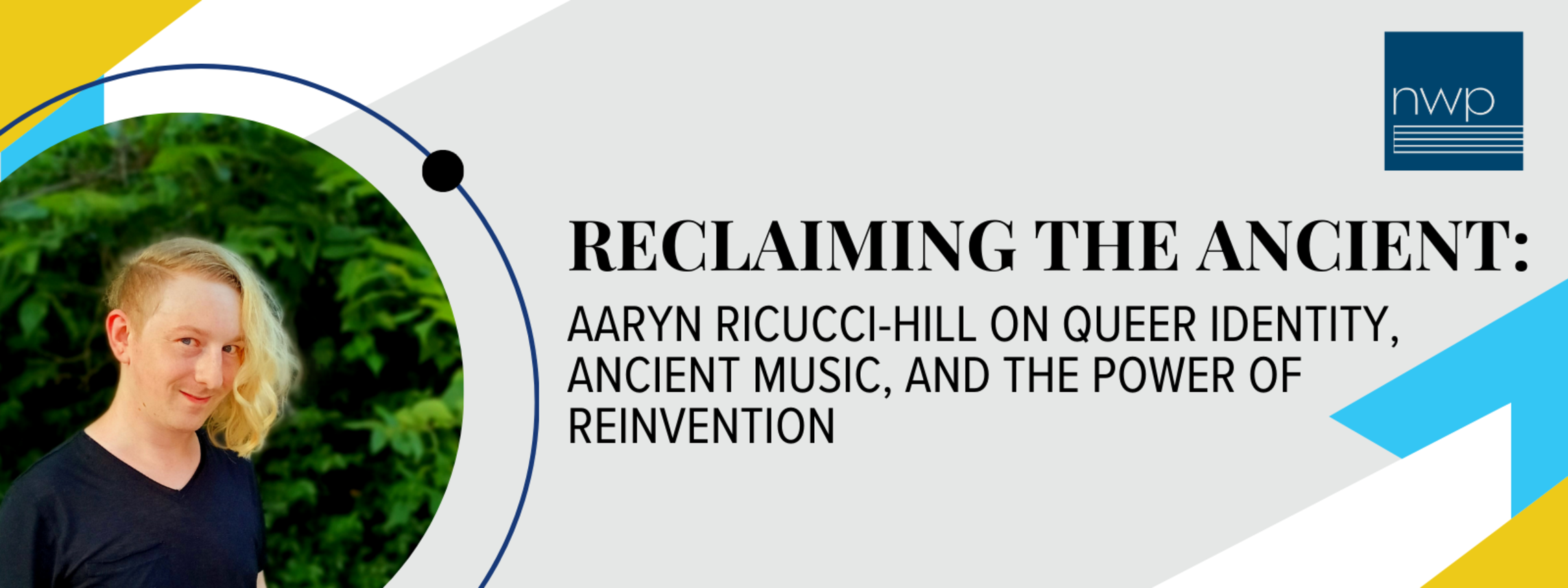
Reclaiming the Ancient: Aaryn Ricucci-Hill on Queer Identity, Ancient Music, and the Power of Reinvention
When composer Aaryn S. Ricucci-Hill began writing Epitaph, they weren’t setting out to make a statement—they were answering a call. That call, as it turns out, was over 2,000 years old.
Built around the Seikilos epitaph—the oldest known complete piece of notated music—Epitaph takes an ancient Greek melody and places it in a strikingly modern, yet reverent, harmonic frame. Written for solo organ, the piece is spacious and meditative, a sonic ritual that doesn’t try to reinvent the wheel. Instead, it quietly rotates within it.
For Aaryn, this project wasn’t just a composition. It was a balancing act: honoring the past while making room for their voice in the present.
“I don’t really do anything to the melody itself,” Aaryn explains. “The Greeks had a very specific idea of harmony—usually no more than two voices. But I take this single line and surround it with my own harmonic world, still keeping that sense of ancientness intact.”
The result is a haunting and reflective work that feels both reverent and subversive. The organ—one of humanity’s oldest instruments—becomes a time-traveling vessel. And while the melody remains almost untouched, the space around it hums with tension, shimmer, and restraint.
But Epitaph is only the first half of the journey.
A Companion in Fragments
Its sister piece, Evocations II, continues the exploration of antiquity but through a fractured lens. Based on the fragmentary Delphic Hymns to Apollo, this piece doesn’t attempt to reconstruct what’s missing. Instead, it celebrates the cracks.
“There’s a Japanese concept called kintsugi,” Aaryn shares, “where you fill the cracks of broken pottery with gold. That’s the spirit of Evocations II. I take the ancient fragments, and instead of trying to hide what’s gone, I illuminate it.”
Written for solo viola and organ, the piece begins with a quiet, reflective solo—still echoing the meditative restraint of Epitaph—but slowly builds into what Aaryn calls “a bacchanal.” The second half is wild, ecstatic, untamed. Melodic freedom overtakes formality, and the tension finally unravels.
“When performed together,” Aaryn says, “the pieces form an arc. Epitaph is tight, focused, contemplative. Then Evocations II loosens that grip, bit by bit, until we’re fully unbound. It’s a ritual of release.”
Ancient Melodies, Contemporary Questions
The pairing of these two works—commissioned as part of New Works Project’s 10th season—raises deeper questions: What does it mean to reclaim history? Who has the right to interpret sacred texts? What happens when a queer, contemporary artist puts their fingerprints on melodies once used for worship?
“I think a lot about reverence,” Aaryn says. “There are still people today who use these hymns in their spiritual practice. I don’t want to be careless with that. But at the same time, I believe my voice belongs here too.”
Their approach isn’t about provocation—it’s about presence. Through thoughtful reinterpretation, Aaryn resists the notion that tradition is static. They demonstrate, instead, that tradition is an ongoing dialogue. And that queer artists deserve to speak back to the canon.
A Composer Without a Keyboard
Surprisingly, Aaryn doesn’t own a piano—and hasn’t since 2018. While many composers use the instrument as a sounding board, Aaryn finds it limiting.
“If I sit at a piano,” they say, “I start writing things I can play, not necessarily what I want to hear.”
Instead, they compose by ear and imagination, sketching ideas directly into notation software. This frees them from the physical boundaries of the keyboard—and opens up a sonic world that’s deeply internal, intuitive, and unbound by fingerings or muscle memory.
The process is a dance between structure and spontaneity. “I always start by throwing things at the wall,” Aaryn laughs. “Eventually, I’ll shape it into something coherent. But I always leave room for those 5 a.m. ideas that just demand to be heard.”
Artistic Identity, Queer Perspective
It would be impossible to talk about Aaryn’s music without acknowledging their identity—and how that identity permeates their creative life.
“I like to think everything I write is queer,” Aaryn says. “Even if the piece is abstract or doesn’t have a narrative, it still carries that imprint. Because I carry that imprint.”
In their words, queerness is not a theme—it’s a lens. It’s the filter through which they perceive the world, and therefore, the source of all expression. Whether quoting Oscar Wilde by accident or channeling ballroom culture through electronic beats, Aaryn brings their full self into their work—unapologetically and powerfully.
This includes humor, too.
“Classical music can be petty and hilarious,” Aaryn says, grinning. “Debussy wrote a whole piece mocking Wagner. Sati was just shitposting in manuscript form. There’s absolutely room for camp.”
One of their electronic works—a mashup of Handel’s coronation anthems and club beats—was originally conceived as a commentary on queer realness and royal aesthetics. But when a professor called it “accidental camp,” Aaryn embraced it fully.
“I didn’t mean for it to be funny,” they admit. “But it was. And in that humor, people were more open to the message.”
Looking Forward by Looking Back
As the classical music world grapples with inclusion, accessibility, and relevance, artists like Aaryn Ricucci-Hill are offering a path forward—one rooted in radical imagination, deep listening, and unapologetic identity.
Through Epitaph and Evocations II, they invite us not only to hear the past—but to reimagine our place within it.
“History doesn’t belong to one kind of person,” Aaryn says. “And neither does music.”
by : Austin McFarland